My final project displays the ways in which my physical and emotional location shapes the story I tell about sharks and the ocean as “home.” I’m not from an area close to the ocean, nor do I share the ocean as a lived environment. Instead, my relationship to it has always been built through longing, imagination, and pictures, particularly of sharks. Documentaries, Shark Week, aquariums, childhood books, and even the looming shadow of Jaws helped form my relationship to the ocean and one of its key inhabitants, sharks. Because of this difference, my point of view is both admiring and self-critical. I tell a story about sharks that is driven by love, but I also acknowledge that this love comes from a place of fantasy, not experience. My documentary voice emerges through contrast and comparison, peaceful underwater visuals paired with the unsettling intrusion of pollution and human harm, as well as quotes from Spielberg in regards to the negative side effects of his hit movie. Rather than relying on a scientific basis, I lean on provocative imagery, narration, and ambient sound (such as with the boat’s motor or the calm ocean waves) to “show” how sharks inhabit their home and how humans disrupt it. This allows the sharks to appear not as statistics or symbols, but as residents of a place that has been misunderstood and invaded. By centering the ocean as a shared home and exposing how fear has displaced its true inhabitants, my project reflects my belief that environmental storytelling must engage with both love and responsibility. My documentary ultimately argues that care begins with reimagining the stories we tell, whether it be about nature, about fear, or stereotyped animals who are simply existing in their home.
Author: admin
-
Creating Moral Bridges: The Power of Our Location
One thing that would stay with me after this course is Robert Coles’s idea of location. As children, we were always told not to brag about certain things or not take things for granted, so subconsciously and unknowingly, we have, in a way, taken into account our own location. And by doing this, it shaped our experiences and moral development.
I like how Coles used Ruby Bridges as a prime example of remembering our location. His concept highlights how a child’s innocent perspective is profoundly affected by the hostile, racially charged environment of her school and the surrounding community, yet also how this location forged her extraordinary courage and moral strength. Coles addressed his “location” with Ruby Bridges by being a physically present and a consistent source of support, but his indirect approach focused on her experiences, allowing his racial identity to be understood through their interactions and the context of their time, rather than explicit, overt discussions of his whiteness; and this is seen within his book about Ruby.
The mixed school is what pushed Ruby, but her strength was not diminished by it; instead, it was forged through it, and she continued to pray for the people who wished horrible things upon her. The pressure put upon her was immense, and it eventually took a psychological toll, which humanized her story beyond a historical event. Her story emphasizes how a single individual, situated in a hostile “location,” can inspire significant social and moral change, making her a lasting symbol of the fight against injustice.
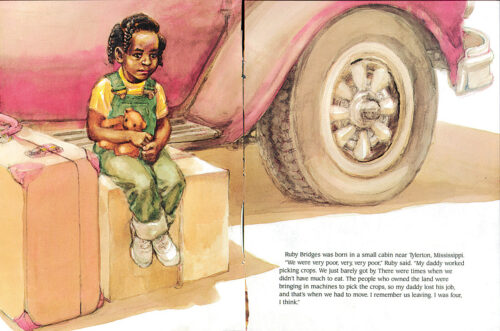
Coles, Robert. The Story of Ruby Bridges. Illustrated by George Ford, Scholastic, 1995.
-
60 Second Documentary
The choices that shaped my documentary Shared Waters came from my love of sharks and my desire to preserve them and their home. Since I was a child, I’ve been fascinated by the ocean and the life it holds, but as I learned more about shark finning, pollution, and population decline due to media and misrepresentation of sharks, I felt a sense of responsibility to make a change in the view of them with the newer generation. I wanted this project to show sharks not as the villains they are often made out to be, but as essential inhabitants of a shared home that humans have neglected and harmed. Remember, they can only live in water, and they were here long before we were. The more we damage their home and their populations, the more consequences it’ll have on us in the future.
My project also reflects my own location and point of view. Although I do not live near the ocean, I’ve always felt a deep connection to it, seeing it as a space of calm and belonging. That distance made me realize how easy it is for people to feel detached from the harm we cause to places we don’t inhabit directly. In Shared Waters, I speak from that place of reflection and guilt as I am just a simple person who admires the ocean from afar, yet I contribute to its declineby being unable to directly help or raise more awareness about the situation. The film became a reminder that “home” extends beyond human boundaries and that protecting the homes of other species, such as sharks, is also part of protecting our own.
-
Through A Moral Frame, Dignity and Displacement in Dorothea Lange’s Lens
Estelle Ishigo’s “Determination, rain or shine” depicts a solitary Japanese American woman standing against a cold wind in a World War II incarceration camp. The sketch’s rough lines mirror the barrenness of the camp itself: snow covering the ground, low barracks in the background, and a woman dressed for the weather as her scarf whips against the air. Despite the weather, the woman stands upright, displaying her resilience, cutting through the desolation.
This drawing resonates with Dorothea Lange’s work documenting Japanese American internment. In “Dorothea Lange: Grab a Hunk of Lightning”, Lange is shown as an artist who refused to look away. Her photography is viewed through a moral vision, with an insistence on seeing people not as subjects but as fellow people caught in unjust systems. She wants to extract the universality of the situation, not the circumstances.
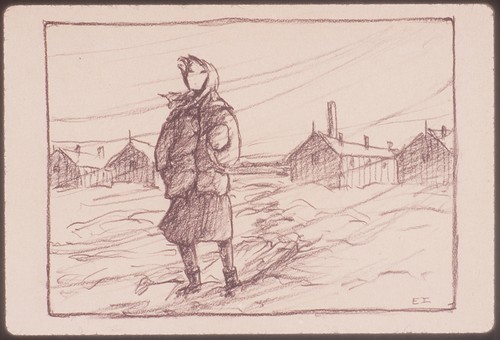
Ishigo, Estelle. Determination, rain or shine. ca. 1942–1945. UCLA Library Special Collections.
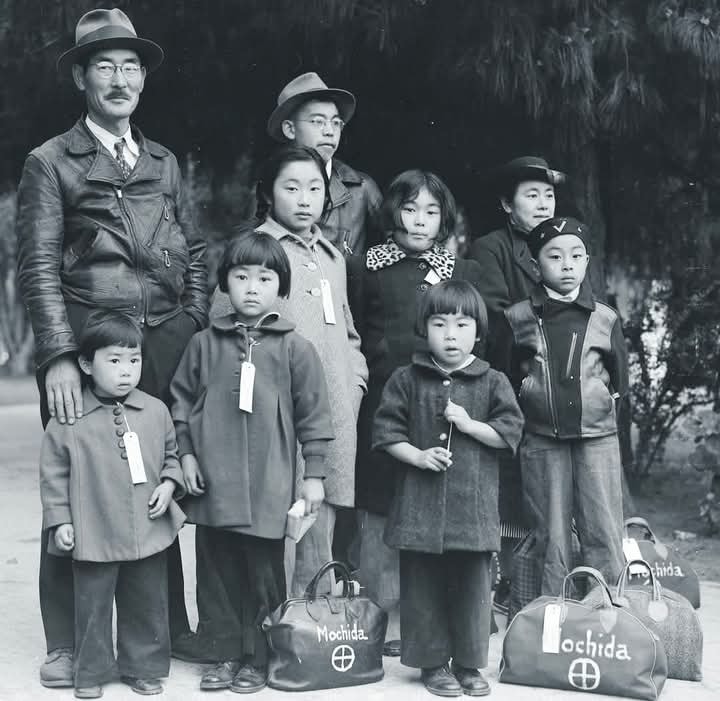
In Lange’s “Grab a Hunk of Lightning”, she shows photographs of tagged families waiting for relocation, called “Members of the Mochida family awaiting evacuation bus”, which echoes the quiet but loud endurance Ishigo captures in the drawing. The Mochida family, consisting of adults and children, stands stiffly, each wearing an official identification tag. Lange captures what others may see as invisible, as something that needs to be visible: the dignity held within displacement. As Robert Coles notes in “Doing Documentary Work”, true documentaries enter the lives of others not to use them but to learn from them, “our documentary efforts to learn from others about what they were doing…and our efforts to fit what we had learned…into a presentation…”(Coles 43). The Mochida family, standing together and facing the camera, embodies this ethical exchange. Lange’s photograph forces us to see the humanity and strength behind this historical wrong, a strength we might otherwise choose to ignore. She uses her craft to gain knowledge and transform documentation into empathy.
Dorothea Lange: Grab a Hunk of Lightning. Directed by Dyanna Taylor, performance by Dorothea Lange, American Masters, PBS, 2014.
Dorothea Lange, Members of the Mochida family awaiting evacuation bus…, May 8, 1942, Hayward, California. U.S. National Archives and Records Administration
-
Stranger With a Camera
A moment in “Stranger with a Camera” by Elizabeth Barret that stands out to me is when Bobby Kennedy visited eastern Kentucky with a camera crew following his every movement. He visited some of the poorest areas; the main purpose of this trip was to highlight Appalachian poverty for the nation. The moral and psychological tension in this scene coincides with the contradictory reactions of the people being filmed. Some residents hoped that media attention would improve their lives, that national visibility would lead to investment or reform. Others, however, objected to that, feeling as if they would be blamed for the conditions that are portrayed (photo 1). In addition, there is a deep sense of violation and shame, as if the camera transformed their everyday hardships into a spectacle of pity. Barret captures this tension through careful editing, contrasting idealistic commentary about Kennedy’s “war on poverty” with the guarded or resentful expressions of those being recorded. The film makes visible a painful question: does being seen by the outside world bring dignity, or does it take it away? Baret also states that she “found these films insulting…when filmmakers only focused on the deprivation and didn’t look past it at the people who are the real wealth of the culture” (Barret Stranger with a Camera), meaning that she wanted to focus on the people rather than what surrounds them, which is ironic because as shown in the photo 2, she states this in a “god like” voice over on pictures of areas in poverty with no people.
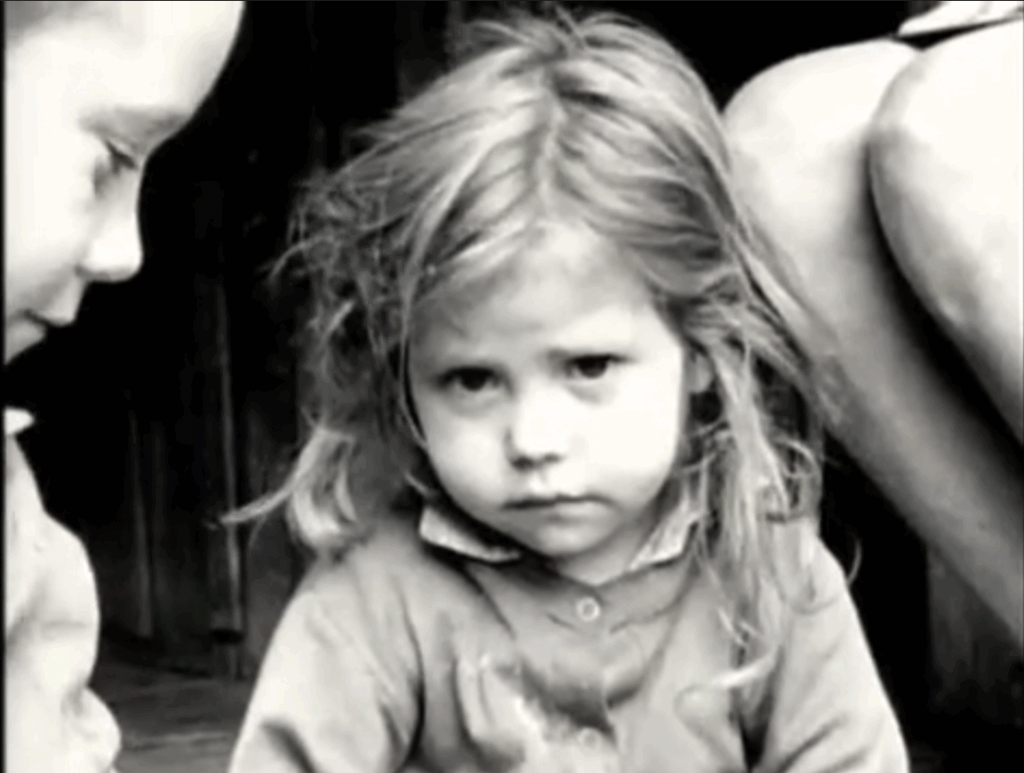
Photo 1. “Boy smiling with girl looking sad, camera work from Bobby Kennedy visit,” Elizabeth Barret, Stranger with a Camera, 2000.
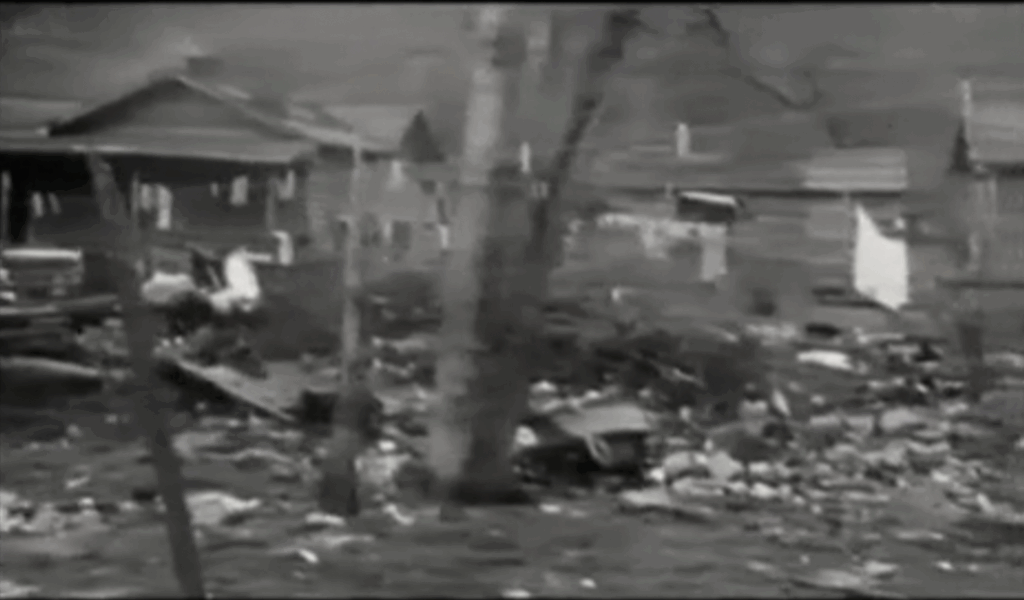
Photo 2. “Photo of place of poverty in Kentucky,” Elizabeth Barret, Stranger with a Camera, 2000
This tension reflects what Robert Coles describes in “Doing Documentary Work”, when he writes that a documentary “attempts to portray a particular life realistically…through informants, witnesses, participants, … the camera and tape recorder…” (Coles 5). Coles points out that such portrayals always involve mediation with the filmmaker’s tools, choices, and perspective, shaping what reality becomes visible. Even with the goal of honesty, documentation changes the people and places it touches. Barret’s film takes this insight seriously, acknowledging that the very act of filming is never innocent; it carries moral responsibility as well as responsibility to the people and community it represents.
Barret addresses the issue through self-scrutiny by acknowledging that she is both an insider and an outsider, an Appalachian who also belongs to the same media culture that once misrepresented her community. Through her narration and reflective tone, she continually questions her authority to tell this story. Rather than pretending to offer an objective account, Barret uses “Stranger with a Camera” to question her authority, exploring how storytelling can cause more harm when it is meant to heal. In doing so, she enacts the ethical modesty that Coles calls for, documentary work that constantly interrogates its own power to represent, and its limits in capturing another’s truth.
-
Coles’ “Location” With Agee
In the introduction of “Doing Documentary Work”, Coles describes his conversations with James Agee, who reflected on what it meant to write about the tenant farmer families he had met in July of 1936. Agee was aware of his “location”, simply not in Alabama, rather, his social positions as an educated white man, writing about the cruel radiance of people’s struggles that he himself couldn’t experience, creating self-disgust within himself as well, since he is powerless to remedy the situation. Agee’s work helped to open Coles’ perspectives and became an example of how “location” is simply not a neutral location; rather, it’s a multifaceted experience that shapes how an observer notices and interprets the lives of others, and how it affects their physical/psychological state, community, and moral compass. “We notice what we notice in accordance with who we are” (Coles Introduction 7), recognizing that one’s position, biases, and responsibilities are essential pieces to understanding “location” as well as documentary work.
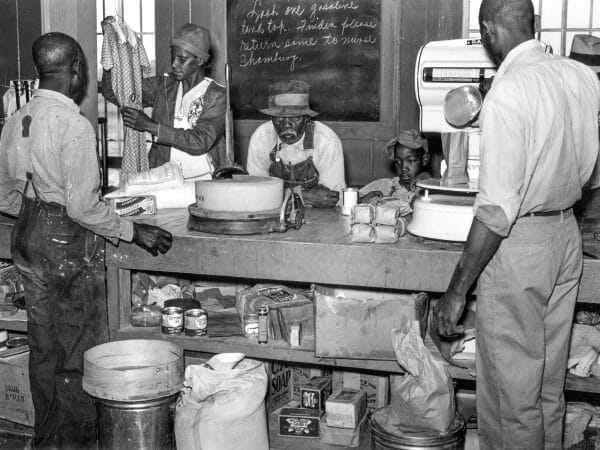
(Winemiller Gee’s Bend Cooperative Store)
The picture depicted above shows a group of people in the Gee’s Bend Cooperative Store, located in the Black Belt Region of Alabama. Although it’s stated in the introduction that the location was “a kind of earth, rich and productive for growing crops” (Coles Introduction 1), one of the defining cultural traits for the Black Belt is “an African American population at or above 50 percent” (Winemiller Black Belt Region in Alabama). The high percentage of African Americans in Black Belt counties furthered the distance of Agee’s being and theirs. In his passages, he revealed “how much we can take for granted, if we are certain people and if certain other people are our sponsors” (Coles Introduction 7). This portrays how, even though they are in the same location and are both people, there is still a social difference between him and the tenant farmer families that he observed and talked to, realizing that there is an obvious reality of the observed vs the observing, and they have their own notion of what the other intends on doing based on their appearance and background.
Cole’s idea of “location” reminds me of a time in middle school when I bought a sleeping bag for a homeless man as he was shivering due to the fall weather, with little money and a kid’s blanket. We were both physically in the same place, feeling the cool breeze in the air, but our social places were vastly different. Similar to Agee acknowledging the gap between him and the tenant farmers, I became aware of our contrasting positions: me having the ability to respond to the change in temperature, and his position, facing the cold without shelter or warmth. Thinking back to that moment, I realize that being in the same physical location does not mean having the same or similar living experience, as “location” is shaped not just by a geographical standpoint but also by privilege and circumstance. In both Coles’s analysis of Agee and my experience, “location” evolves into something more than where we are physically; it is the social, emotional, and ethical position we occupy in reference to others.
-
A Move and Ties to Coles
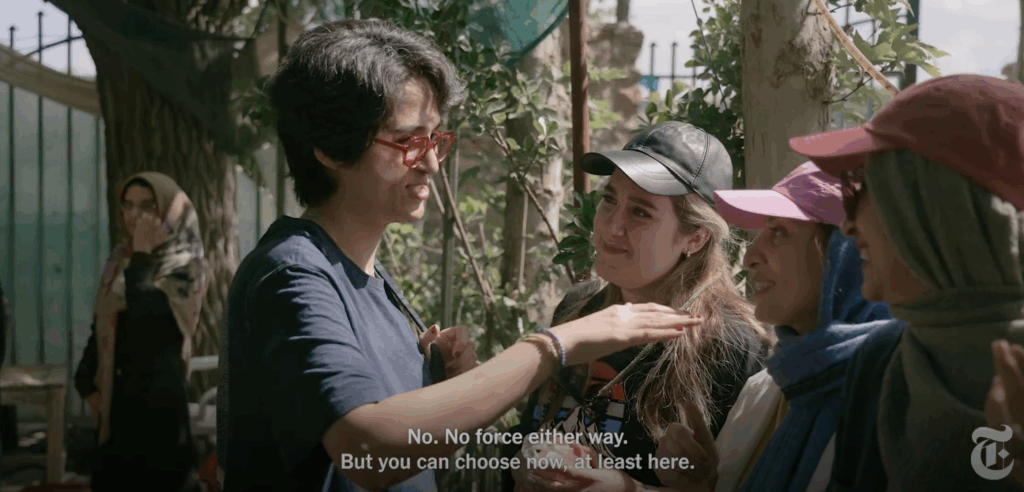
The “field”, as Coles describes, is the act of “what happens morally and psychologically within us, and what subsequently happens to us” (Coles Introduction 14) or a place where an observer’s experience significantly shapes their work and transforms the observer. In “A Move“, Esmaili reflects this view as she expresses her individuality, breaking free of the political oppression within the private space of her family.
Her field is not depicted as a stable sanctuary; rather, a site of negotiation, as she is pleaded with to wear a hijab or some sort of hat by her family members before walking into the gathering, since it is customary for women to do so. This act of resistance transforms the gathering into a political stage where the generational differences collide(displayed in the first photo). This displays Coles’ dimensions of the field as Esmaili places herself in this situation; she doesn’t simply just observe, she also embodies the tensions that her camera wants to capture and what she wants to portray. In addition, the use of multiple voices, silences, facial looks, and time spent on scenes carries meaning. For example, towards the end of the film, we see the camera focus on Esmaili and another person cleaning windows for a few seconds. At that angle, it seems like they are a reflection of each other, one set in the traditional ways and one breaking free, but both are still the same nonetheless, bound by family ties. This scene (shown in the second photo) portrays the complexities of “home” as being both a space of connection but also ressistance.
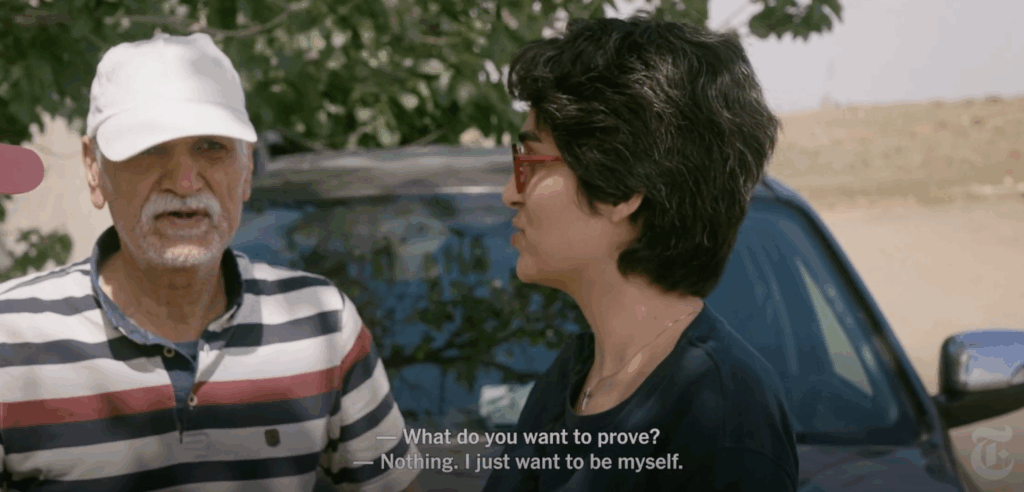
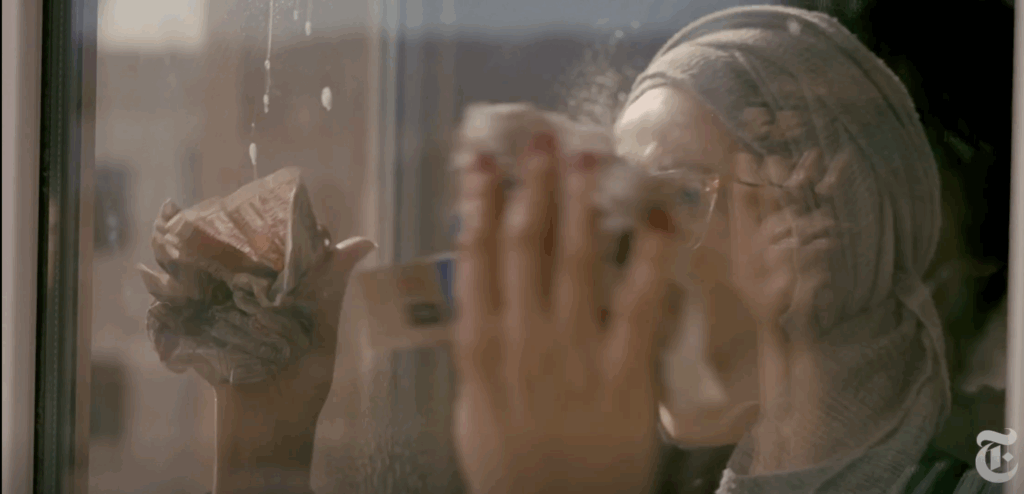
“A Move” embodies Coles’ goal by showing what happens when a filmmaker enters spaces that are both familiar (her family home) and morally doubtful (“streets not our own”). Esmaili enacts this process by turning her camera on her family, while also situating that domestic disruption within the larger political rupture caused by Mahsa Amini’s death.
The film shows how venturing into the “streets” of home and family unsettles both the subject and filmmaker. Arriving without a hijab during family rituals, Esmaili crosses into uncharted waters, testing the limits of tradition and authority (picture 3). This act isn’t a neutral observation; it changes her, revealing her own vulnerabilities and moral commitments. Coles argues that the field reshapes us as much as we document it, and Esmaili exemplifies this by making her personal beliefs inseparable from the film.